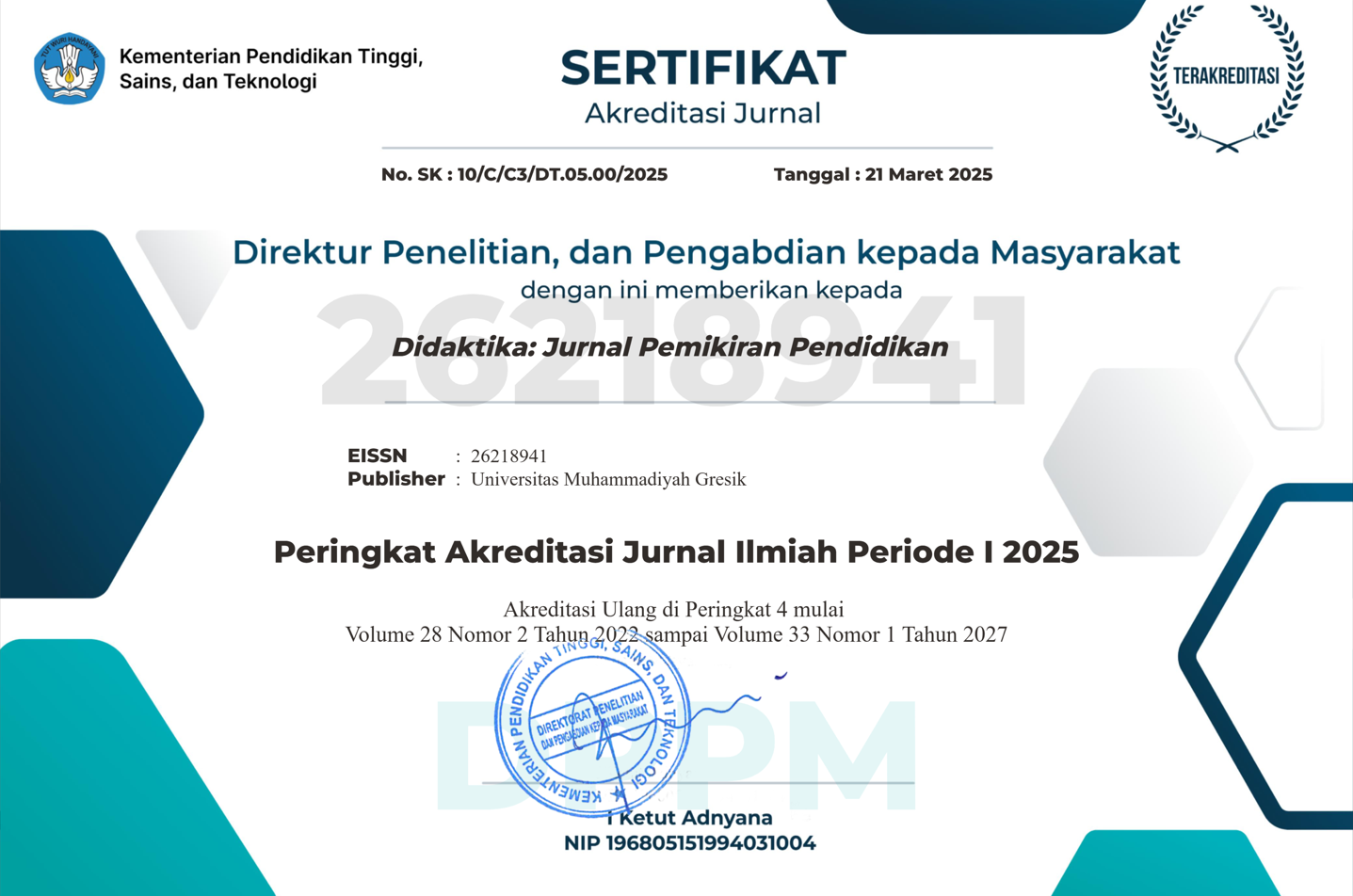
Analysis of Students' Emotional Intelligence in STEM Based Robotics Learning using Transcript Based Lesson Analysis (TBLA)
DOI:
https://doi.org/10.30587/didaktika.v32i1.9595Keywords:
Leson Study, Robotic, Emotional, TBLAAbstract
This study aims to analyze students' emotional intelligence in robotics learning using a STEM approach. This study was conducted at Nurul Ilmi Integrated Islamic Junior High School in Jambi, with the research subjects being students involved in robotics learning. The researcher acted as an observer who passively observed the learning process without direct intervention. The observation and analysis process was based on emotional intelligence indicators that had been validated by experts. The lesson study activity was carried out in three cycles, each consisting of Planning (Plan), Implementation (Do), and Evaluation (See), which were adjusted to the allocated time and robotics learning materials that had been determined. Data was collected through voice recordings during the activities, then converted into conversation transcripts and analyzed. The data is presented in a table of transcript analysis results based on emotional intelligence indicators and a graph of analysis results that presents the transcripts. The transcripts are analyzed to identify students' emotional intelligence indicators using Microsoft Excel, and the analysis results are visualized in the form of line diagrams
Downloads
References
Aini, N., Susanti, N., & Nurhatmi, J. (2024). Penelitian Kualitatif dalam Pembelajaran Lesson Study pada Mata Kuliah Perubahan Iklim Berbasis NVivo Pendahuluan. Jurnal Pembelajaran Fisika, 13(4), 200–210. https://doi.org/10.19184/jpf.v13i3.48554
Anggraini, C. N., Susanti, N., Dani, R., & Maryanti, I. (2024). Analisis Kesesuaian Proses Pembelajaran Fisika dengan RPP Pada Materi Fluida Statis Di MAS Laboratorium Melalui Pengamatan Video Pembelajaran Menggunakan TBLA. Jurnal Pemikiran Pendidikan, 30(1), 48–57. https://doi.org/10.30587/didaktika.v30i1.6923
Asri, Y. N. (2018). Pembelajaran Berbasis Stem Melalui Pelatihan Robotika. WaPFi (Wahana Pendidikan Fisika), 3(2), 74. https://doi.org/10.17509/wapfi.v3i2.13735
Creswell, J. W. (2018). Qualitative, Quantitative, and Mixed Methods Approaches. In Writing Center Talk over Time. https://doi.org/10.4324/9780429469237-3
Djoko Hari Supriyanto. (2021). Analisis Pengaruh Kecerdasan Emosional Terhadap Proses Berfikir Siswa Kelas IV dalam Memecahkan Masalah Matematika. Jurnal Pendidikan Modern, 6(2), 85–90. https://doi.org/10.37471/jpm.v6i2.208
Hanik, E. U., & Ulfa, M. (2021). Pembelajaran Berbasis Stem Melalui Media Robotik Untuk Meningkatkan Keterampilan Siswa Abad 21 Sekolah Indonesia Kuala Lumpur ( Sikl ). International Conference on Islamic Education, 1, 83–96.
Latip, A. (2020). Minat Belajar Peserta Didik SMP Pada Pembelajaran STEM dengan Media Robot Edukasi. Jurnal Literasi Pendidikan Fisika, 1(02), 90–96. https://doi.org/10.30872/jlpf.v1i2.353
Lisnawati, S. (2019). Development of Emotional Quotient Instrument. Jurnal Evaluasi Pendidikan, 2(1), 54. https://doi.org/10.21009/jep.021.05
Masban, B. R. (2022). Pengaruh Pembelajaran Berbasis Stem Terhadap Pemahaman Konsep Dan Kemampuan Bekerjasama Peserta Didik Pada Materi Elektroplating Di Sma Negeri 1 Sakra. Indonesian Journal of Teacher Education, 3(1), 352–361.
Masniari, D., Susanti, N., Lestari, N., & Gustria, A. (2023). Describing Student Activeness Using Transcript Based Lesson Analysis In Lesson Study Material Hydrostatic Pressure And Pascal’s Law. DIDAKTIKA : Jurnal Pemikiran Pendidikan, 29(2), 152. https://doi.org/10.30587/didaktika.v29i2.5438
Pulsande, A. S. (2021). Analisis Pembelajaran Ipa Dengan Lesson Study Berbasis Transcript Based Lesson Analysis Pada Materi Getaran Dan Gelombang. Jurnal Sains Dan Pendidikan Fisika, 17(2), 128–138.
Rahmaniar, A., & Latief, A. (2021). Analisis Literatur Teknologi dalam Integrasi Pendidikan STEM pada Pembelajaran IPA. Jurnal Literasi Pendidikan Fisika (JLPF), 2(2), 143–148. https://doi.org/10.30872/jlpf.v2i2.680
Riantoni, C., Fuady, S., Hais, Y. R., & Novallyan, D. (2023). Workshop STEM Robotik Bagi Siswa dan Guru di SMPN 32 Muaro Jambi STEM Robotics Workshop for Students and Teachers at SMPN 32 Muaro Jambi. Jurnal Anugerah, 5(x), 61–72.
Rifudin, R., Setiawan, A., Abidin, Z., Efrilianda, D. A., & Jumanto. (2022). Pembelajaran STEM Berbasis Robotika Sederhana Bagi Guru Sekolah Dasar di Karimunjawa. Abdimasku : Jurnal Pengabdian Masyarakat, 5(3), 570. https://doi.org/10.33633/ja.v5i3.825
Selvia, Susanti, N., Alrizal, & Khoiriyah. (2024). Identifikasi Kemandirian Belajar Siswa di Ma Nurul Islam Lumajang Pada Materi Fluida Dinamis Melalui Pengamatan Video Berbasis TBLA. Didaktika Jurnal Pemikiran Pendidikan, 30(1), 34–47. https://doi.org/10.30587/didaktika.v30i1.6921
Setyaningrum, R., Utami, H. N., & Ruhana, I. (2016). Pengaruh Kecerdasaan Emosional Terhadap Kinerja. Jurnal Administrasi Bisnis (JAB)|Vol, 36(1), 211–220.
Siti Anisah, A., Katmajaya, S., & Zakiyyah, W. L. (2021). Pengaruh Kecerdasan Emosional Terhadap Sikap Sosial Pada Siswa Sekolah Dasar. Jurnal Pendidikan UNIGA, 15(1), 434. https://doi.org/10.52434/jp.v15i1.1178
Wahidin, M. S., Darsono, & Astuti, N. (2019). Hubungan Pendidikan Karakter dan Kecedasan Emosional dengan Hasil Belajar PKn. Pedagogi: Jurnal Pendidikan Dasar, 7(13).

Downloads
Published
How to Cite
Issue
Section
License
Copyright (c) 2026 Publisher Fakultas Keguruan dan Ilmu Pendidikan Universitas Muhammadiyah Gresik

This work is licensed under a Creative Commons Attribution-NonCommercial 4.0 International License.
License and Copyright Agreement
In submitting the manuscript to the journal, the authors certify that:
- They are authorized by their co-authors to enter into these arrangements.
- The work described has not been formally published before, except in the form of an abstract or as part of a published lecture, review, thesis, or overlay journal.
- That it is not under consideration for publication elsewhere,
- That its publication has been approved by all the author(s) and by the responsible authorities – tacitly or explicitly – of the institutes where the work has been carried out.
- They secure the right to reproduce any material that has already been published or copyrighted elsewhere.
- They agree to the following license and copyright agreement.
Copyright
Authors who publish with DIDAKTIKA: Jurnal Pemikiran Pendidikan agree to the following terms:
- Authors retain copyright and grant the journal right of first publication with the work simultaneously licensed under a Creative Commons Attribution License (CC BY-SA 4.0) that allows others to share the work with an acknowledgment of the work's authorship and initial publication in this journal.
- Authors are able to enter into separate, additional contractual arrangements for the non-exclusive distribution of the journal's published version of the work (e.g., post it to an institutional repository or publish it in a book), with an acknowledgment of its initial publication in this journal.
- Authors are permitted and encouraged to post their work online (e.g., in institutional repositories or on their website) prior to and during the submission process, as it can lead to productive exchanges, as well as earlier and greater citation of published work.
Licensing for Data Publication
Open Data and Software Publishing and Sharing
The journal strives to maximize the replicability of the research published in it. Authors are thus required to share all data, code or protocols underlying the research reported in their articles. Exceptions are permitted but have to be justified in a written public statement accompanying the article.
Datasets and software should be deposited and permanently archived inappropriate, trusted, general, or domain-specific repositories (please consult http://service.re3data.org and/or software repositories such as GitHub, GitLab, Bioinformatics.org, or equivalent). The associated persistent identifiers (e.g. DOI, or others) of the dataset(s) must be included in the data or software resources section of the article. Reference(s) to datasets and software should also be included in the reference list of the article with DOIs (where available). Where no domain-specific data repository exists, authors should deposit their datasets in a general repository such as ZENODO, Dryad, Dataverse, or others.
Small data may also be published as data files or packages supplementary to a research article, however, the authors should prefer in all cases a deposition in data repositories.