Pola Rentang Perhatian Anak Usia 4–5 Tahun dalam Pembelajaran Berbasis Sentra: Studi Kasus di TK Alam Yaa Bunayya
DOI:
https://doi.org/10.30587/jieec.v8i2.11839Keywords:
Attention Span, Childern Aged 4-5 Years, Case Study, Early Childhood EducationAbstract
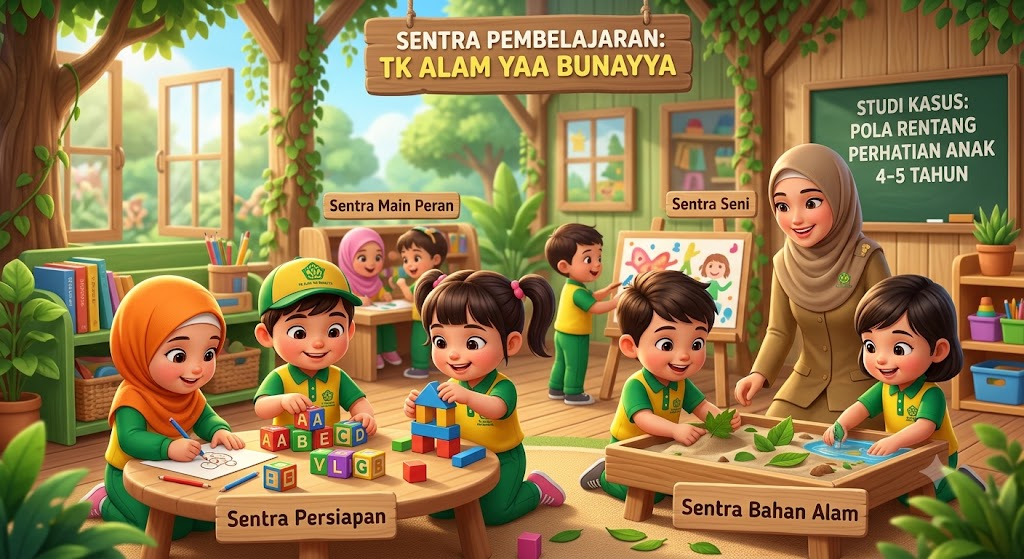
Attention span is a fundamental aspect of early childhood cognitive development, as it influences children's ability to participate in learning activities, follow instructions, and complete assigned tasks. This study aims to analyze the attention span patterns of children aged 4–5 years in center-based learning at TK Alam Yaa Bunayya, identify the factors influencing fluctuations in their attention, and explore the implications for instructional practices. This research employed a qualitative approach using a case study design. The participants consisted of three children aged 4–5 years who were selected through purposive sampling. Data were collected through classroom observations, interviews with teachers and parents, and documentation, and were analyzed using the interactive model of Miles, Huberman, and Saldaña, including data reduction, data display, and conclusion drawing and verification. The findings revealed that each child demonstrated a distinct attention span pattern across different learning centers. The nature center and art center generated longer attention spans than the preparation and Islamic values/literacy centers because they provided more concrete, exploratory, and hands-on learning experiences. Variations in attention span were influenced by four major factors: children's interest in the activity, the learning environment, self-regulation, and the support strategies employed by teachers and parents. The study concludes that children's attention span is a dynamic and contextual phenomenon shaped by the interaction between individual characteristics and the design of center-based learning activities. These findings contribute to the development of more adaptive and child-centered instructional strategies that accommodate individual differences in attention during early childhood education.
Downloads
References
Ahsin, L. C. I., Istiyani, D., & Fatmawati, N. M. (2025). Mengembangkan Keterampilan Sosial Anak Usia Dini Melalui Pembelajaran Kisah Khalifah Utsman bin Affan dengan Media Wayang Kertas. Aulad: Journal on Early Childhood, 8(2), 576–586. https://doi.org/10.31004/aulad.v8i2.866
Al-Maidah. (2015). PENANAMAN NILAI-NILAI TAUHID PADA ANAK USIA DINI DENGAN MODELPEMBELAJARAN SENTRA (STUDI KASUS PENDIDIKAN AGAMA ISLAM DI TK YAA BUNAYYA SURABAYA). Universitas Muhammadiyah Surabaya.
Arianto, B. (2024). Triangulasi Metoda Penelitian Kualitatif. In Borneo Novelty Publishing. Borneo Novelty Publishing.
Banu, S., & Manik, N. D. Y. (2021). Pengaruh Pendidikan Karakter Anak Usia Dini Pada Keluarga Yang Tidak Memiliki Ayah. Didache: Jurnal Teologi Dan Pendidikan Kristiani, 3(1), 73–83. https://doi.org/10.55076/didache.v3i1.49
Denny Shinta Rahmawati, Kuni Fatonah, & Elyaum Farihah. (2025). Manajemen Pengelolaan Kelas dalam Praktik Bercerita dari Buku pada Anak Usia Dini Di TK Dharma Wanita Sriwedari. JIEEC (Journal of Islamic Education for Early Childhood)., 7(2), 24–32. https://doi.org/10.30587/jieec.v7i2.10020
Eka Fitriana. (2018). MODEL PEMBELAJARAN SENTRA DI TAMAN KANAK-KANAK ISLAM TERPADU (IT) QURROTA A’YUN BANDAR LAMPUNG. Universitas Lampung.
Herliyana, B., & Maslahah, T. (2025). Relevansi Teori Perkembangan Piaget dan Erikson dalam Pembentukan Karakter dan Kognisi Anak di Era Digital. Jurnal Educazione : Jurnal Pendidikan, Pembelajaran Dan Bimbingan Dan Konseling, 13(1), 29–41. https://doi.org/10.56013/edu.v13i1.3739
Husnah, A. (2024). 9 PENERAPAN MODEL PEMBELAJARAN SENTRA BERMAIN PERAN DALAM UPAYA MENINGKATKAN SOSIAL EMOSIONAL ANAK USIA DINI 4-5 TAHUN. At-Thufuly: Jurnal Pendidikan Anak Usia Dini, 4(2), 67–82.
Iwi Masika. (2025). STRATEGI GURU PENDIDIKAN ANAK USIA DINI (PAUD) DALAM MENGEMBANGKAN KECERDASAN NATURALIS ANAK MELALUI SENTRA BAHAN ALAM DI TK NEGERI PEMBINA 1 KOTA BENGKULU. Universitas Islam Negeri Fatmawati Sukarno Bengkulu.
Mauluddia, Y., & Solehuddin, M. (2023). The Application of Playing in Early Childhood Education Based on Piaget’s Way of Thinking. Al-Athfaal: Jurnal Ilmiah Pendidikan Anak Usia Dini, 6(2), 143. https://doi.org/10.24042/00202361730300
Maylia, E. C., Amelia, A. P., Suwarna, D. M., Muyassaroh, I., & Jenuri, J. (2024). Strategi Pembelajaran Inkuiri Terhadap Kemampuan Berpikir Kritis Siswa SD. Jurnal Review Pendidikan Dasar : Jurnal Kajian Pendidikan Dan Hasil Penelitian, 10(1), 32–41. https://doi.org/10.26740/jrpd.v10n1.p32-41
Moleong J lexy. (2018). Metode Penelitian Kualitatif. PT Rosdakarya.
Mushab Al Umairi. (2024). Reinforcement terhadap Sosial Emosional Anak Usia Dini Di Era Society 5.0. IJECIE: Indonesian Journal of Early Childhood Islamic Education, 5(2), 45–97.
Novitasari, Y., & Fauziddin, M. (2022). Analisis Literasi Digital Tenaga Pendidik pada Pendidikan Anak Usia Dini. Jurnal Obsesi : Jurnal Pendidikan Anak Usia Dini, 6(4), 3570–3577. https://doi.org/10.31004/obsesi.v6i4.2333
Nuryati, D. W., Masitoh, S., & Arianto, F. (2020). Pengaruh Project Based Learning Terhadap Kreativitas Peserta Didik di Masa Pandemi. Educate : Jurnal Teknologi Pendidikan, 5(2), 98–106. https://doi.org/10.32832/educate.v5i2.3375
Ratnasari, N., Tadjudin, N., Syazali, M., Mujib, M., & Andriani, S. (2018). Project Based Learning (PjBL) Model on the Mathematical Representation Ability. Tadris: Jurnal Keguruan Dan Ilmu Tarbiyah, 3(1), 47. https://doi.org/10.24042/tadris.v3i1.2535
Sarnoto, A. Z. (2022). Komunikasi Efektif pada ‘Anak Usia Dini dalam Keluarga Menurut Al-Qur’an. Jurnal Obsesi : Jurnal Pendidikan Anak Usia Dini, 6(3), 2359–2369. https://doi.org/10.31004/obsesi.v6i3.1829
Sidiq, A. M., & Rohma, N. S. (2024). Pemberian Reward dan Kelekatan Anak dengan Ibu terhadap Tingkat Kemandirian Anak Usia 5-6 Tahun Di Sekolah KB-RA Ukhuwah Al-Ikhlash Kureksari. JIEEC (Journal of Islamic Education for Early Childhood), 6(2), 68. https://doi.org/10.30587/jieec.v6i2.7992
Sidiq, A. Miranti. M. A. U. (2022). Social Development of Early Children in Online Learning in the Time of the Covid-19 Pandemic. IJECES: Indonesian Journal of Early Childhood Education Studies, 11(2). https://doi.org/https://doi.org/10.15294/ijeces.v11i2.57676
Sugiyono. (2018). Metode Penelitian Kuantitatif, Kualitatif, R dan D. Alfabeta.
Zahra Nur Aziza, Suryadi, Revina Rizqiyani, Kisno, & Edi Dwi Cahyo. (2025). Pengaruh Metode Bermain Sambil Belajar terhadap Anak Hyperaktif. JIEEC (Journal of Islamic Education for Early Childhood)., 7(2), 55–62. https://doi.org/10.30587/jieec.v7i2.10132
Zamzami, E. M. (2021). Aplikasi Edutainment Pendukung Pembelajaran Jarak Jauh TK Merujuk Standar Nasional PAUD. Jurnal Obsesi: Jurnal Pendidikan Anak Usia Dini, 5(2), 985–995.
Downloads
Published
How to Cite
Issue
Section