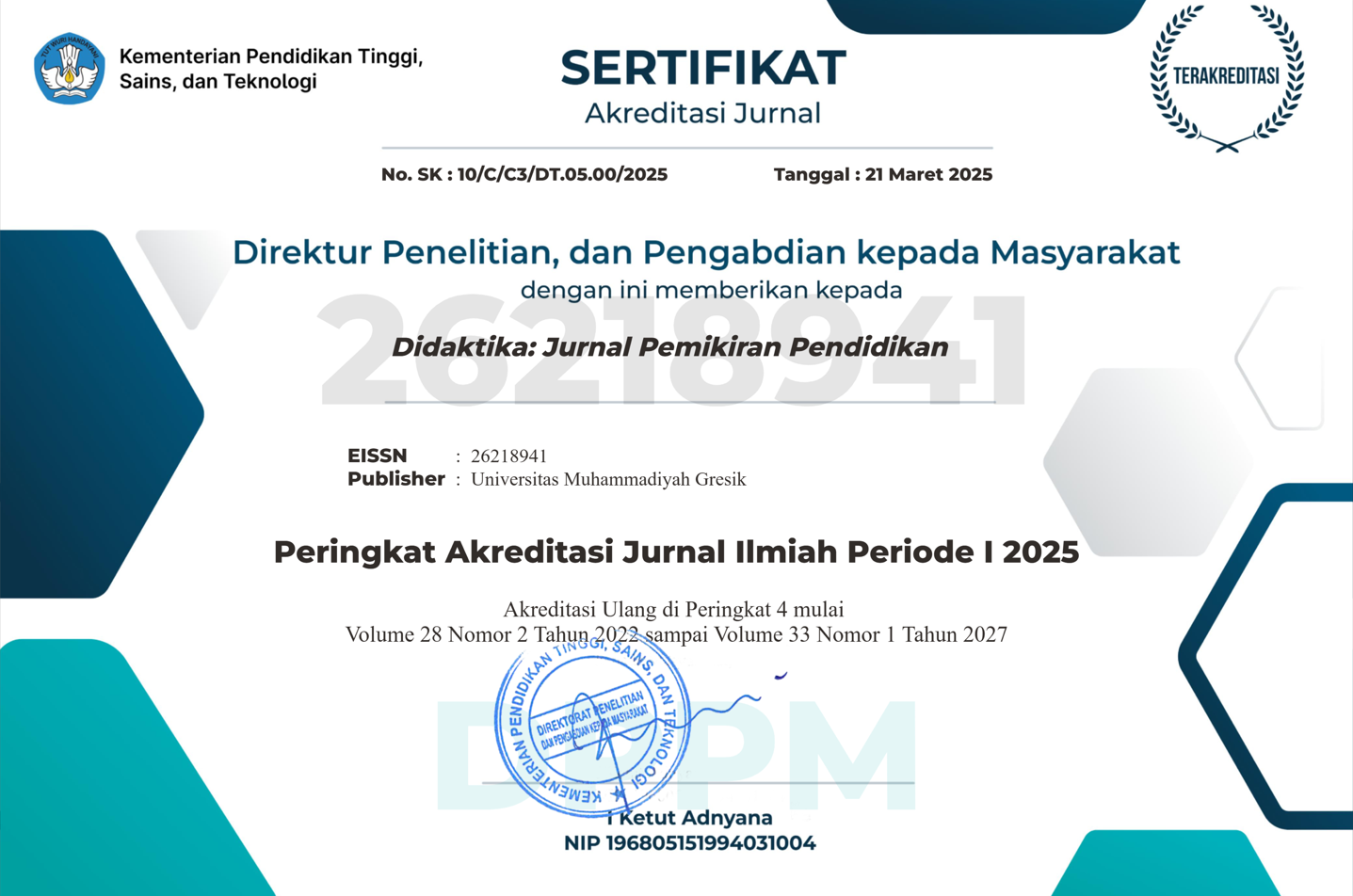
The Effect Of Using Edpuzzle Learning Media On Learning Outcomes In The Subject Of Energy Transformation Around Us In Grade IV Of Paninggaran Public Elementary School
DOI:
https://doi.org/10.30587/didaktika.v32i1.10531Keywords:
Edpuzzle, Learning Outcomes, Energy TransformationAbstract
This study aims to determine the effect of using Edpuzzle learning media on student learning outcomes in the subject of energy transformation around us. The method used is quantitative with a quasi-experimental Nonequivalent Control Group Design. The research subjects are fourth-grade students at Paninggaran State Elementary School. Data were collected through pretest and posttest assessments, which were analyzed using a t-test. The results of the study indicate that the use of Edpuzzle learning media significantly impacts improvements in student learning outcomes. This media makes learning more interactive, engaging, and easier to understand, thereby helping students remain focused and motivated in their studies.
Downloads
References
Agustin, S. E., Yandari, I. A. V., & Yuhana, Y. (2024). Pengembangan Media Pembelajaran Berbasis Aplikasi Edpuzzle Pada Materi Bangun Datar Kelas IV Sekolah Dasar. Jurnal Ilmiah Profesi Pendidikan, 9(1), 119–128. https://doi.org/10.29303/jipp.v9i1.1839
Amirah Zahra Muthi, Nuraida Rezeki Fadhilah, Desy Safitri, & Sujarwo Sujarwo. (2023). Efektivitas Penerapan Media Pembelajaran Video Dokumenter dalam Pembelajaran IPS pada Siswa SMP. Morfologi: Jurnal Ilmu Pendidikan, Bahasa, Sastra Dan Budaya, 1(6), 104–116. https://doi.org/10.61132/morfologi.v1i6.116
Aprina, E. A., Fatmawati, E., & Suhardi, A. (2024). Penerapan Model Problem Based Learning Untuk Mengembangkan Keterampilan Berpikir Kritis Pada Muatan IPA Sekolah Dasar. Didaktika: Jurnal Kependidikan, 13(1), 981–990.
Ayuningsih, R. F., Andrianto, D., & Kurniawan, W. (2025). Integrasi Model Pembelajaran Blended Learning Dan Flipped Classroom: Strategi Efektif Dalam Pembelajaran Abad Ke-21. STRATEGY : Jurnal Inovasi Strategi Dan Model Pembelajaran, 5(1), 10–21. https://doi.org/10.51878/strategi.v5i1.4942
Dewi, P. A. C. (2024). Workshop Penggunaan Media Pembelajaran Edpuzzle untuk Meningkatkan Kompetensi Guru. JIIP - Jurnal Ilmiah Ilmu Pendidikan, 7(9), 10017–10021. https://doi.org/10.54371/jiip.v7i9.5921
Gusti, I., Ngurah, A., Jayantika, T., Made, N., & Andini, P. (2022). Emasains Jurnal Edukasi Matematika dan Sains 85 JEms Media Pembelajaran Berbasis Edpuzzle Pada Pembelajaran Matematika. Jurnal Edukasi Matematika Dan Sains, XI(2), 1. Retrieved from https://edpuzzle.com/
Hukom, J., Arab, P. B., & Makassar, U. N. (2025). Durasi video pembelajaran dalam flipped classroom : tinjauan naratif terhadap dampaknya pada keterlibatan dan. 02, 116–121.
Mailani, E., Rarastika, N., Saragih, H. A., Butar, G. J. P., & Tarigan, O. G. (2025). Peningkatan Keterampilan Berpikir Kritis Siswa Kelas 3 SD Melalui Pembelajaran Matematika Dengan Pendekatan Deep Learning Dan Media Interaktif. Journal Educational Research and Development, 01(04), 417–424.
Manurung, A. S., Fahrurrozi, F., Utomo, E., & Gumelar, G. (2023). Implementasi berpikir kritis dalam upaya mengembangkan kemampuan berpikir kreatif mahasiswa. Jurnal Papeda: Jurnal Publikasi Pendidikan Dasar, 5(2), 120-132. Jurnal Papeda, 5(2), 120–132.
Nirmala, S. U., Agustina, A., Robiah, S., & Ningsi, A. (2023). Penerapan Media Pembelajaran Berbasis Teknologi Informasi dan Komunikasi pada Kurikulum Merdeka di Sekolah Dasar. Ideguru: Jurnal Karya Ilmiah Guru, 9(1), 182–187. https://doi.org/10.51169/ideguru.v9i1.746
Prasetya, A. D., Utama, A. H., & Mastur, M. (2024). Pemanfaatan Sosial Media Sebagai Penyajian Konten Pembelajaran Digital: Study Literature Review. Jurnal Riset Dan Inovasi Pembelajaran, 4(2), 1004–1017. https://doi.org/10.51574/jrip.v4i2.1702
Restu Kurnia, I., & Titin Sunaryati. (2023). Media Pembelajaran Video Berbasis Aplikasi Canva Untuk Meningkatkan Minat Belajar Siswa. Jurnal Educatio FKIP UNMA, 9(3), 1357–1363. https://doi.org/10.31949/educatio.v9i3.5579
Saparudin, S., Puspita, Y., & Ramadhani, E. (2025). PENGARUH PENGGUNAAN MEDIA EDPUZZLE TERHADAP HASIL BELAJAR SISWA PADA PELAJARAN BAHASA INDONESIA Saparudin. Concept and Communication, 10(2), 301–316. https://doi.org/10.15797/concom.2019..23.009
Sofianah, M. D., & Sholihah, M. (2024). Model Pembelajaran Flipped Classroom Sebagai Upaya Peningkatan Keterampilan Berbahasa Siswa Di Madrasah Ibtidaiyah. MODELING: Jurnal Program Studi PGMI, 11(1), 774–790.
Sukma, R. R., Ismiyanti, Y., & Ulia, N. (2022). Pengaruh Blended Learning dengan model Flipped Classroom berbantuan video terhadap hasil belajar kognitif kompetensi IPA kelas V. Jurnal Ilmiah Pendidikan Dasar, 9(2), 142. https://doi.org/10.30659/pendas.9.2.142-156
Taib, M. (2021). Pembelajaran IPA Berbasis Mind Mapping dalam Pengembangan Kemampuan Berpikir Kritis, Kreatif, Komunikatif, dan Kolaboratif. Jurnal Didaktika Pendidikan Dasar, 5(2), 465–486. https://doi.org/10.26811/didaktika.v5i2.345
Wardani, N. W., Kusumaningsih, W., & Kusniati, S. (2024). Analisis Penggunaan Media Pembelajaran terhadap Hasil Belajar Siswa Sekolah Dasar. Jurnal Inovasi, Evaluasi Dan Pengembangan Pembelajaran (JIEPP), 4(1), 134–140. https://doi.org/10.54371/jiepp.v4i1.389
Yeni, D. F., Rahmatika, D., Muriani, M., & Armi Eka Putri, D. (2023). Pengaruh Penggunaan Media Pembelajaran Digital terhadap Hasil Belajar Siswa. Edu Journal Innovation in Learning and Education, 1(2), 93–102. https://doi.org/10.55352/edu.v1i2.571

Downloads
Published
How to Cite
Issue
Section
License
Copyright (c) 2026 Publisher Fakultas Keguruan dan Ilmu Pendidikan Universitas Muhammadiyah Gresik

This work is licensed under a Creative Commons Attribution-NonCommercial 4.0 International License.
License and Copyright Agreement
In submitting the manuscript to the journal, the authors certify that:
- They are authorized by their co-authors to enter into these arrangements.
- The work described has not been formally published before, except in the form of an abstract or as part of a published lecture, review, thesis, or overlay journal.
- That it is not under consideration for publication elsewhere,
- That its publication has been approved by all the author(s) and by the responsible authorities – tacitly or explicitly – of the institutes where the work has been carried out.
- They secure the right to reproduce any material that has already been published or copyrighted elsewhere.
- They agree to the following license and copyright agreement.
Copyright
Authors who publish with DIDAKTIKA: Jurnal Pemikiran Pendidikan agree to the following terms:
- Authors retain copyright and grant the journal right of first publication with the work simultaneously licensed under a Creative Commons Attribution License (CC BY-SA 4.0) that allows others to share the work with an acknowledgment of the work's authorship and initial publication in this journal.
- Authors are able to enter into separate, additional contractual arrangements for the non-exclusive distribution of the journal's published version of the work (e.g., post it to an institutional repository or publish it in a book), with an acknowledgment of its initial publication in this journal.
- Authors are permitted and encouraged to post their work online (e.g., in institutional repositories or on their website) prior to and during the submission process, as it can lead to productive exchanges, as well as earlier and greater citation of published work.
Licensing for Data Publication
Open Data and Software Publishing and Sharing
The journal strives to maximize the replicability of the research published in it. Authors are thus required to share all data, code or protocols underlying the research reported in their articles. Exceptions are permitted but have to be justified in a written public statement accompanying the article.
Datasets and software should be deposited and permanently archived inappropriate, trusted, general, or domain-specific repositories (please consult http://service.re3data.org and/or software repositories such as GitHub, GitLab, Bioinformatics.org, or equivalent). The associated persistent identifiers (e.g. DOI, or others) of the dataset(s) must be included in the data or software resources section of the article. Reference(s) to datasets and software should also be included in the reference list of the article with DOIs (where available). Where no domain-specific data repository exists, authors should deposit their datasets in a general repository such as ZENODO, Dryad, Dataverse, or others.
Small data may also be published as data files or packages supplementary to a research article, however, the authors should prefer in all cases a deposition in data repositories.