

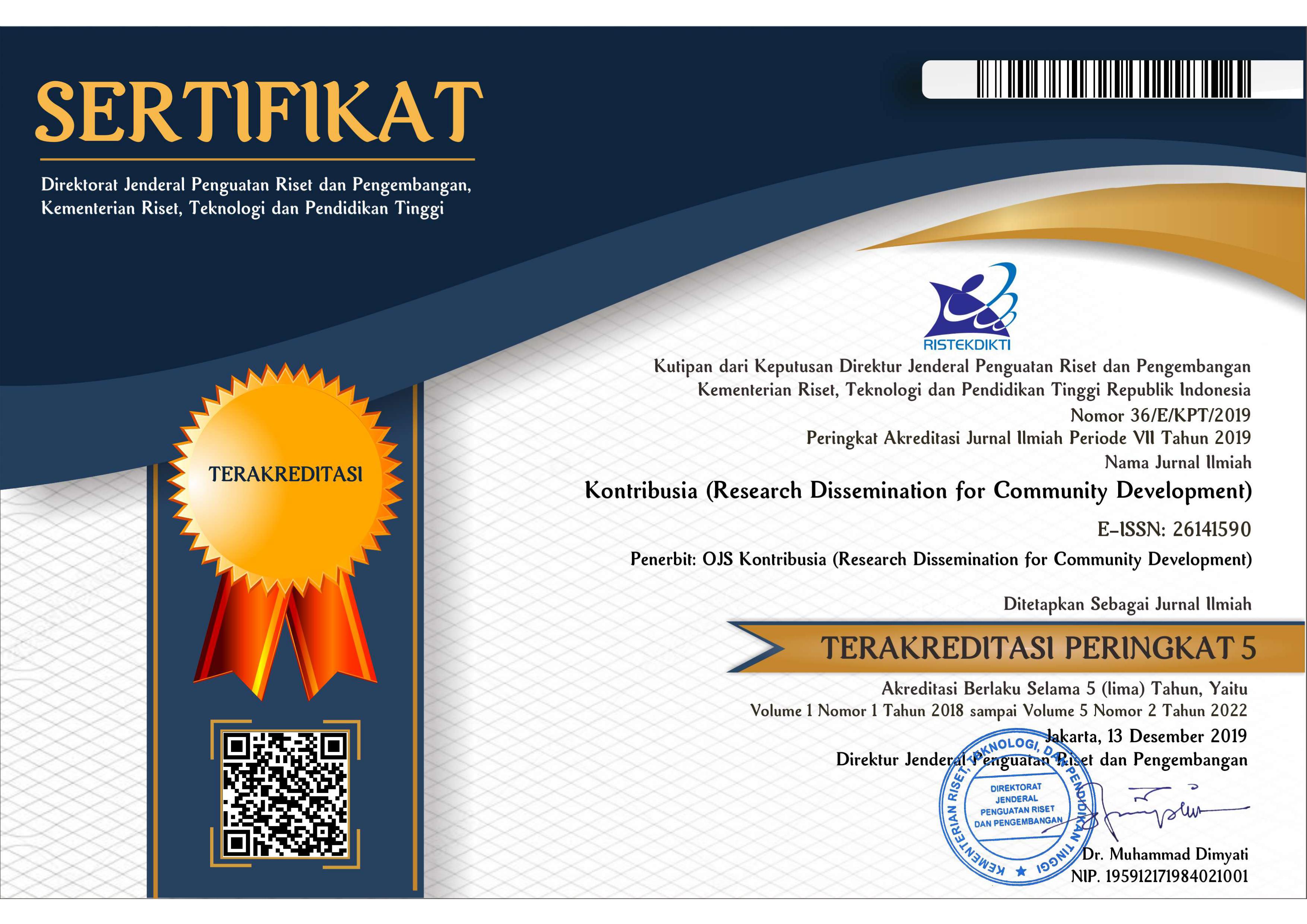

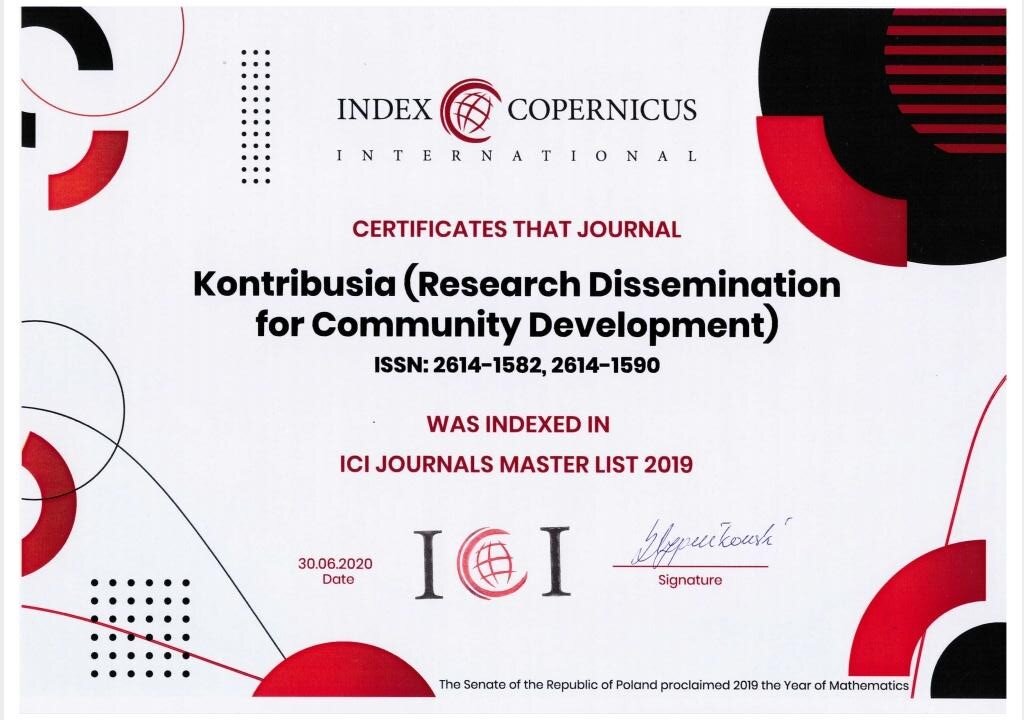



Before prepare and submit article manuscripts, please note that author(s) are discouraged from withdrawing submitted papers after it is in the publication process (review, copyedit, layout, etc.,). During the time, Kontribusia : Research Dissemination for Community Development, had spent valuable resources besides time spent in the process.
Kontribusia : Research Dissemination for Community Development accepts the following types of papers:
The Author’s Guideline of Kontribusia : Research Dissemination for Community Development
Kontribusia : Research Dissemination for Community Development a national scientific journal is open to seeking innovation, creativity, and novelty. Kontribusia : Research Dissemination for Community Development is a peer-review journal published by the Universitas Majalengka. The aim of the journal is to facilitate scientific publication of the results of researches in Indonesia and participate to boost the quality and quantity of research for academics and researchers. Kontribusia : Research Dissemination for Community Development published two times a year, in January and August by publishing research results and critical analysis studies. This journal facilitates teachers and researchers to disseminate their research expertise through community services on the field of Education, Economic, Religious, Health, Agriculture, Engineering, and Psychology.
The Manuscript General Guidelines
The manuscript text general guidelines are as follows:
The Guidelines for the Manuscript Body Text
The title of the manuscript: The title should be informative and be written both briefly and clearly. It cannot diverse multi interpretations. It has to be pinpoint with the issues that will be discussed. The beginning word is written in capital case and symmetrically. The article title does not contain any uncommon abbreviation. The main ideas should be written first and followed then by its explanations. The article title should be written within twenty words, 12pt-sized font, with the bold selection and in the center text format.
Author Details and Authorship: All contributing authors’ names should be added, and their names arranged in the correct order for publication. A correct email address should be supplied only by the corresponding author. The full name of each author must be present in the exact format they should appear for publication, including or exclude any middle names or initials as required. The affiliation of each contributing author should be correct on their individual author name. The maximum number of authors is five people.
The criteria of authorship are as follows; Substantial contributions to the conception or design of the work; or the acquisition, analysis, or interpretation of data for the work; Drafting the work or revising it critically for important intellectual content; Final approval of the version to be published; Agreement to be accountable for all aspects of the work in ensuring that questions related to the accuracy or integrity of any part of the work are appropriately investigated and resolved.
Abstract: The abstract has to be written within 200 words maximum and followed by with three to five keywords and arranged alphabetically. Abstract must contain research objectives, methods, result, conclusion and limitation (optional). Authors should provide appropriate and short keywords that encapsulate the principal topics of the paper 3-5 phrases. Abstract written in 1 space line and 10 font size Times New Rowman. For the key word font size 10.
Introduction: The introduction must contain (sortly and consecutively) a general background and a literature review (state of the art) as the basic of the brand new research question, statements of the brand new scientific article, main research problems, and the hypothesis. In the final part of the introduction, the purpose of the article writing should be stated. They should be represented in the literature review to show the brand new of the scientific article.
Methods: The method explains how the research is conducted, including research design, data collection, research instrument and analytic methods. This part should be narated.
Results and Discussion: Write results in a logical sequence. Results with important findings should be present first. When presenting results in a table or figure, do not repeat all those contents in the text. Present only the summary of the text. Describe only new and important aspects of the study. Do not repeat all information from the results section or any section above. Present limitations of the study. Write the issues that are new or unsolved, for future research. This section consists of the information on What/How the presented data were produced, no raw data should be present in the article. The produced data are presented in tables, or figures with an explanation of what is the result/findings from the work. The section will also need to address connections between findings and basic concepts or hypothesis made earlier. Authors should also express whether any arguments were needed relating to other works from other researchers. Write implications made by the work related to theoretical or applications.
Conclusion: This is the final part containing conclusions, limitations and recommendations. The conclusions will be the answers of the hypothesis or research question, the research purposes and the research discoveries. The conclusions should not contain only the repetition of the results and discussions. It should be the summary of the research results as the author expects in the research purposes or the hypothesis. Research limitations and recommendations contain deficiency in the research and suggestions associated with further ideas from the research.
Acknowledgement: Acknowledgements to those who support the research (sponsors and respondents). Families and supervisors are not allowed in this section.
References: All the references that used in the article must be listed in this part. In this part, all the used references must be taken from primary sources (scientific journals and the least number is 80% from all the references) that published in the last ten years.
The Guidelines for the Citations and References
All the served data or quotes in the article taken from the other author articles should attach the reference sources. The references should use a reference application management such as Mendeley, Plagiarism Checker, or Grammary. The writing format that used in Kontribusia : Research Dissemination for Community Development follows the format applied by APA 6th Edition (American Psychological Association). For example:
Figures
All Figures (charts, diagrams, line drawings, web pages/screenshots, and photographic images) should be submitted in electronic form. All Figures should be of high quality, legible and numbered consecutively with Arabic numerals. Graphics may be supplied in color to facilitate their appearance on the online database. Figures created in MS Word, MS PowerPoint, MS Excel should be supplied in their native formats. Electronic figures created in other applications should be copied from the origination software and pasted into MS Word template document. Photographic images should be inserted in the main body of the article and of high quality.
Tables
Tables should be typed and included in the main body of the article. The position of tables should be inserted in the text as close to the point of reference as possible. Ensure that any superscripts or asterisks are shown next to the relevant items and have corresponding explanations displayed as footnotes to the table, figure or plate.
The Online Submission Manuscript Guidelines
The manuscript text must be submitted by one of two systems (the Second procedure is more preferable):


